
Ebola Outbreak Escalates: Nanodigmbio Urgently Deploys Precision Detection Solution
On May 17, 2026, the World Health Organization (WHO) officially declared the outbreak of Bundibugyo ebolavirus disease in the Democratic Republic of the Congo (DRC) and Uganda a Public Health Emergency of International Concern (PHEIC). As of June 15, 2026, the cumulative number of confirmed cases in the DRC alone has risen to 808, including 192 deaths. Case numbers continue to climb rapidly, and the risk of cross-border spread into neighboring countries remains extremely high.
01 The Threat of Ebola Virus
Ebola virus belongs to the genus Orthoebolavirus within the family Filoviridae and is a highly pathogenic, highly lethal zoonotic RNA virus. The disease it causes, officially termed Ebola virus disease (EVD), is classified by the WHO as a priority high-threat infectious disease and is subject to intensive surveillance at international borders, ports, and by military health authorities globally.

Electron micrograph of Ebola virus structure (Image source: U.S. Centers for Disease Control and Prevention (CDC), PHIL#1832)
I. Species and Lethality Rates
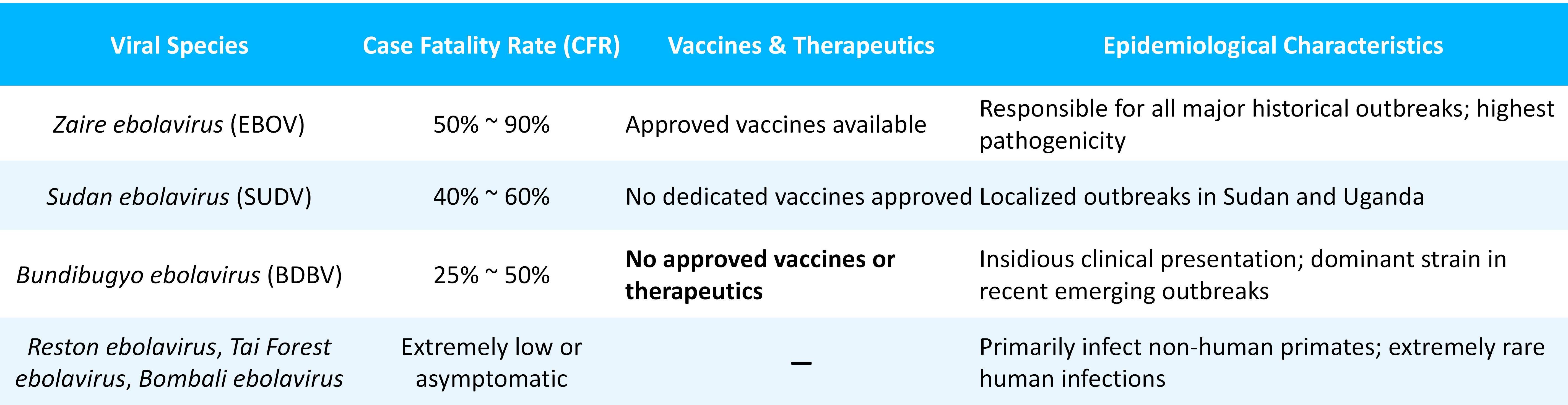
Six distinct species of Ebola virus have been identified to date, differing markedly in geographic distribution, pathogenicity, and vaccine availability.
II. Sources of Infection and Routes of Transmission
① Natural reservoir:The African fruit bat carries the virus asymptomatically and sheds it via saliva, urine, and feces, serving as the primary source of cross-species spillover.
② Intermediate hosts:Wild non-human primates such as chimpanzees and monkeys are prone to death upon infection; humans are highly susceptible when coming into contact with sick or deceased animals.
③Human-to-human transmission:
· Close contact(core route):Transmission through broken skin or mucous membranes upon contact with the body fluids of infected or deceased individuals, including blood, vomit, feces, and sweat. Traditional burial practices involving washing or touching the deceased are significant drivers of clustered infections.
· Nosocomial infection:In settings with inadequate infection control, healthcare workers and caregivers face a high risk of infection.
· Secondary transmission:The virus can persist in the semen of male survivors for an extended period, posing a potential risk of sexual transmission. There is currently no definitive evidence of airborne transmission.
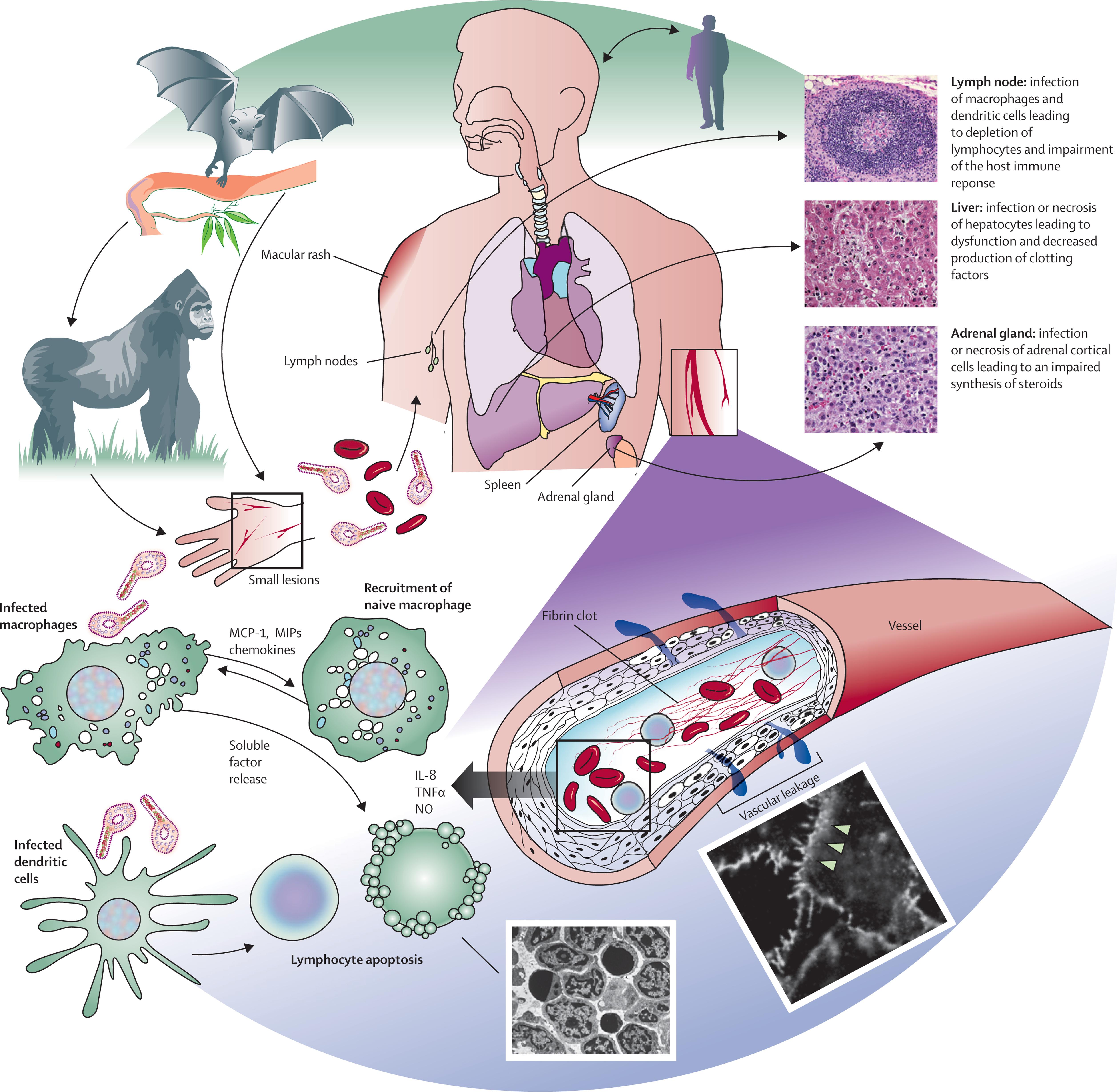
Model of Ebola virus pathogenesis (Image source: The Lancet)
III. Clinical Manifestations and Pathogenesis
1. Incubation period:2 to 21 days (average 8–10 days). Patients are not infectious during the incubation period.
2. Clinical stages:
· Early stage (Prodromal phase):Symptoms include High fever, fatigue, muscle pain, headache, sore throat, easily confused with influenza or malaria, leading to a high rate of missed early diagnosis (particularly pronounced with Bundibugyo ebolavirus).
· Progressive stage:Characterized by severe vomiting, watery diarrhea, and rash, which progresses to widespread mucosal bleeding, subcutaneous ecchymoses, and internal hemorrhage.
· Severe stage:Characterized by disseminated intravascular coagulation (DIC), multi-organ dysfunction, and ultimately death.
3. Pathogenesis:The virus preferentially targets macrophages and dendritic cells, suppressing immune responses and subsequently triggering a "cytokine storm" that destroys the vascular endothelium, leading to widespread bleeding and shock.
02 Detection Challenges with Conventional Methods
2.1 Testing at the frontline of an outbreak faces many challenges:
· Severe sample degradation(due to insufficient cold chain)
· Extremely low viral loads(early stage/incubation period)
· Complex host background(host nucleic acids overwhelmingly dominate in blood/tissue samples)
2.2 Limitations of conventional diagnostic methods:
· Serological testing (ELISA):It comes with a diagnostic window period, as antibodies cannot be detected within days to two weeks after infection, resulting in a high rate of early false negatives.
· RT-PCR:Offers high sensitivity but only targets specific gene segments, making it difficult to detect novel variants or vaccine-escape mutations.
· Conventional metagenomic sequencing (mNGS):It theoretically provides whole-genome coverage, but viral sequences account for an extremely low proportion in clinical specimens, with a long turnaround time (2-3 days) and low detection rates in early-stage or degraded samples.
03 Nanodigmbio’s Emergency Deployment
What outbreak response urgently requires is an integrated solution that delivers high sensitivity, full genome coverage, strong resistance to host background interference, and rapid turnaround. To meet these challenges, Nanodigmbio has launched the μCaler Ebola Virus whole-genome Sequencing End-to-End Solution:
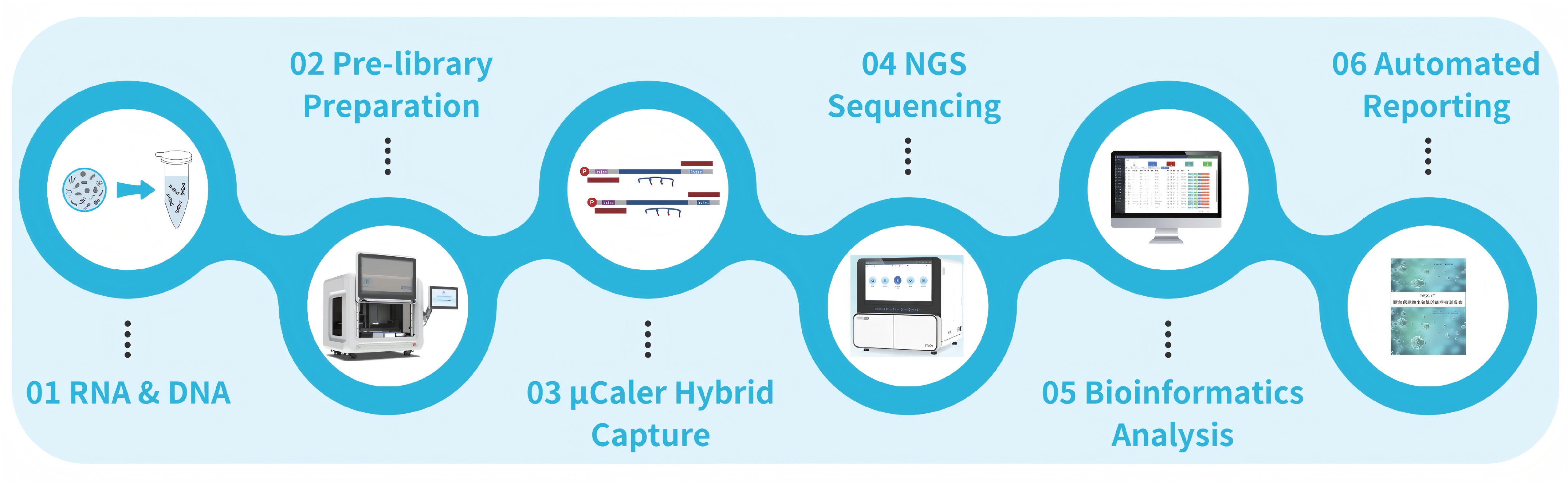
μCaler Ebola Virus whole-genome Sequencing End-to-End Solution
1. Core Technology:Leveraging Nanodigmbio's proprietary μCaler Hybrid Capture Technology and a fully automated workflow platform, the solution integrates rapid discovery, precise identification, and in-depth source tracing. By combining the μCaler Hybrid System with the μCaler EBOV Panel and the XCapViz bioinformatics analysis and visualization suite, it enables a “sample in, result out” workflow in approximately 12 hours. Moreover, the flexible NadAuto series of fully automated NGS workstations can further reduce hands-on time, increase throughput, and free up laboratory personnel.
2. End-to-End Workflow Advantages:
· Complete coverage, no blind spots:Covers the full 18.9 kb Ebola virus genome, including both conserved and hypervariable regions, ensuring no critical variant is missed.
· Precise typing and source tracing:Accurately distinguishes all six Ebola virus species and regional sub-lineages; supports scanning for mutations, insertions/deletions, and recombination events, enabling early warning of vaccine or diagnostic escape risks.
· Optimized for field samples:Achieves >85% genome coverage even at Ct 35 (as validated in viral whole-genome tests for SARS-CoV-2 and norovirus), ensuring robust performance with low-viral-load and partially degraded specimens.
· Rapid and efficient:Delivers results in 12 hours and supports high-throughput batch testing, meeting the needs of both outbreak emergencies and routine surveillance.
· Flexible and expandable:The probe pool can be expanded to enable multiplex detection of Ebola and other high-consequence viruses, such as Marburg virus, Lassa fever virus, and yellow fever virus, in a single assay.
04 Customized Solutions: "Rapid Response" in Outbreak Emergencies
For high-risk pathogens, Nanodigmbio offers professional μCaler custom probe design services:
· Whole genome coverage:Efficiently captures known and potential variants.
· Syndromic panel testing:Enables simultaneous detection of multiple pathogens in a single assay.
· Multi-platform compatibility:Compatible with mainstream sequencing platforms, supporting rapid field deployment.
05 From Precision Detection to Proactive Prevention
As Ebola virus continues to mutate and the risk of cross-border transmission intensifies, the speed of detection, the depth of whole-genome coverage, and the ability to reliably detect low-abundance samples have become decisive technical thresholds for outbreak control.
Nanodigmbio's μCaler Ebola Virus whole genome Sequencing Solution delivers a closed-loop workflow from sample to report. Powered by proprietary technology, it is designed to empower frontline disease control, port and border inspection, military biodefense, and vaccine and therapeutic evaluation — providing a robust technical foundation for global public health security.
Solutions
- Methyl Library Preparation Total Solution
- Sequencing single library on different platform--Universal Stubby Adapter (UDI)
- HRD score Analysis
- Unique Dual Index for MGI platforms
- RNA-Cap Sequencing of Human Respiratory Viruses Including SARS-CoV-2
- Total Solution for RNA-Cap Sequencing
- Total Solution for MGI Platforms
- Whole Exome Sequencing
- Low-frequency Mutation Analysis
Events
-
Exhibition Preview | Nanodigmbio invites you to join us at Boston 2025 Annual Meeting of the American Society of Human Genetics (ASHG)

-
Exhibition Preview | Nanodigmbio Invites You to Join Us at WHX & WHX Labs Kuala Lumpur 2025, Malaysia International Trade and Exhibition Centre in Kuala Lumpur

-
Exhibition Preview | Nanodigmbio Invites You to Join Us at Hospitalar 2025, Brazil International Medical Device Exhibition in São Paulo

-
Exhibition Preview | Nanodigmbio invites you to join us at Denver 2024 Annual Meeting of the American Society of Human Genetics (ASHG)

-
Exhibition Preview | Nanodigmbio invites you to join us at Sapporo 2024 Annual Meeting of the Japan Society of Human Genetics (JSHG)

-
Exhibition Preview | Nanodigmbio invites you to join us at Association for Diagnostics & Laboratory Medicine (ADLM)